




















O Eremita
Arcanos maiores
Resumo da ARCANI
Normal
Prudência e circunspecção; também, e sobretudo, traição e corrupção.
Palavras-chave
- prudência
- circunspecção
- traição
- dissimulação
- corrupção
Invertida
Ocultação e disfarce; política, medo e cautela irrefletida.
Palavras-chave
- ocultação
- disfarce
- medo
- cautela
Notas da imagem · Waite
Trechos das descrições das imagens de Waite, não interpretações adicionais da ARCANI.
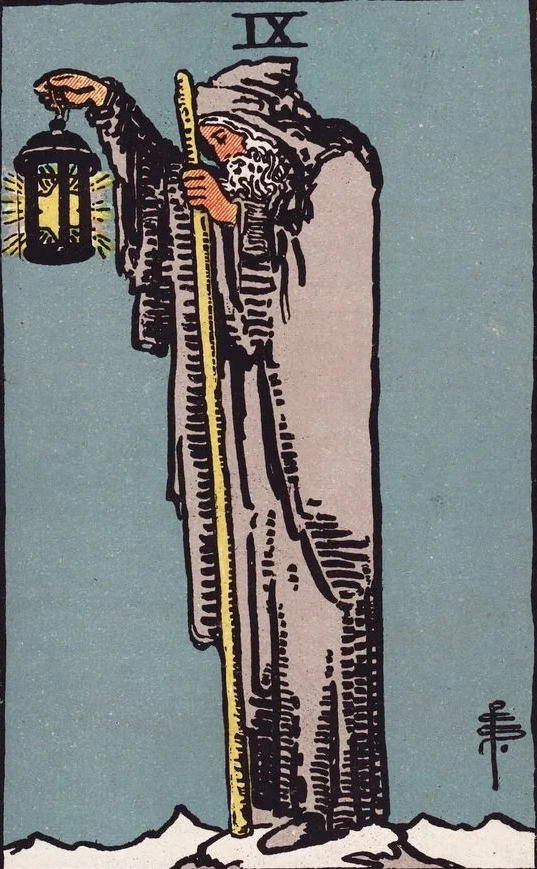
- A variação em relação aos modelos convencionais nesta carta é apenas que a lanterna não está parcialmente envolta no manto de quem a carrega, o qual funde a ideia do Ancião de Dias com a Luz do Mundo
- É uma estrela que brilha na lanterna
- Disse que esta é uma carta de realização e, para ampliar essa conceção, a figura é vista erguendo o seu farol sobre uma eminência
- Portanto o Eremita não é, como explicou Court de Gebelin, um sábio em busca da verdade e da justiça
- nem é, como propõe uma explicação posterior, um exemplo especial de experiência
- O seu farol insinua que "onde eu estou, tu também podes estar." É ainda uma carta entendida de forma bastante incorreta quando se liga à ideia de isolamento oculto, como proteção do magnetismo pessoal contra a mistura
- Esta é uma das interpretações frívolas que devemos a Éliphas Lévi
- Foi adotada pela Ordem francesa do Martinismo e alguns de nós ouviram falar muito da Filosofia Silenciosa e Desconhecida envolta pelo seu manto, longe do conhecimento dos profanos
- No verdadeiro Martinismo, o significado do termo Philosophe inconnu era de outra ordem
- Não se referia à ocultação intencional dos Mistérios Instituídos, muito menos dos seus substitutos, mas, como a própria carta, à verdade de que os Mistérios Divinos asseguram a sua própria proteção contra os que não estão preparados
Descrição da imagem por Waite
The variation from the conventional models in this card is only that the lamp is not enveloped partially in the mantle of its bearer, who blends the idea of the Ancient of Days with the Light of the World. It is a star which shines in the lantern. I have said that this is a card of attainment, and to extend this conception the figure is seen holding up his beacon on an eminence. Therefore the Hermit is not, as Court de Gebelin explained, a wise man in search of truth and justice; nor is he, as a later explanation proposes, an especial example of experience. His beacon intimates that "where I am, you also may be." It is further a card which is understood quite incorrectly when it is connected with the idea of occult isolation, as the protection of personal magnetism against admixture. This is one of the frivolous renderings which we owe to Éliphas Lévi. It has been adopted by the French Order of Martinism and some of us have heard a great deal of the Silent and Unknown Philosophy enveloped by his mantle from the knowledge of the profane. In true Martinism, the significance of the term Philosophe inconnu was of another order. It did not refer to the intended concealment of the Instituted Mysteries, much less of their substitutes, but—like the card itself—to the truth that the Divine Mysteries secure their own protection from those who are unprepared.