A Roda da Fortuna
Arcanos maiores
Resumo da ARCANI
Normal
Destino e fortuna: sucesso, elevação, sorte e felicidade.
Palavras-chave
- destino
- fortuna
- sucesso
- elevação
- sorte
- felicidade
Invertida
Aumento, abundância e superfluidade.
Palavras-chave
- aumento
- abundância
- superfluidade
Notas da imagem · Waite
Trechos das descrições das imagens de Waite, não interpretações adicionais da ARCANI.
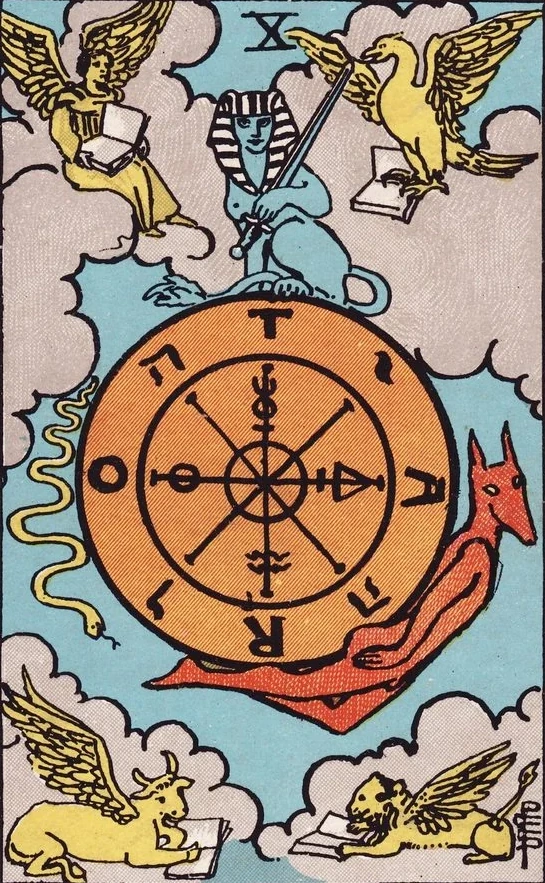
- Neste símbolo segui novamente a reconstrução de Éliphas Lévi, que forneceu várias variantes
- É legítimo, como insinuei, usar o simbolismo egípcio quando este serve ao nosso propósito, desde que não se implique com isso nenhuma teoria de origem
- Apresentei, no entanto, Tífon na sua forma de serpente
- O simbolismo não é, naturalmente, exclusivamente egípcio, pois as quatro Criaturas Vivas de Ezequiel ocupam os ângulos da carta, e a própria roda segue outras indicações de Lévi a respeito da visão de Ezequiel, como ilustrativas daquela Chave particular do Tarot
- Com o ocultista francês, e no próprio desenho, a imagem simbólica representa o movimento perpétuo de um universo fluídico e o fluxo da vida humana
- A Esfinge é o equilíbrio nisso
- A transliteração de Taro como Rota está inscrita na roda, alternada com as letras do Nome Divino, para mostrar que a Providência está implícita em tudo
- Mas esta é a intenção divina interior, e a intenção semelhante exterior é exemplificada pelas quatro Criaturas Vivas
- Por vezes a esfinge é representada deitada sobre um pedestal acima, o que falseia o simbolismo ao anular a ideia essencial de estabilidade em meio ao movimento
- Por trás da noção geral expressa no símbolo está a negação do acaso e a fatalidade que nele se implica
- Pode acrescentar-se que, desde os dias de Lévi, as explicações ocultas desta carta são, mesmo para o próprio ocultismo, de uma espécie singularmente fátua
- Foi dito que significa princípio, fecundidade, honra viril, autoridade governante, etc
- Os achados da adivinhação comum são melhores do que isso no seu próprio plano
Descrição da imagem por Waite
In this symbol I have again followed the reconstruction of Éliphas Lévi, who has furnished several variants. It is legitimate—as I have intimated—to use Egyptian symbolism when this serves our purpose, provided that no theory of origin is implied therein. I have, however, presented Typhon in his serpent form. The symbolism is, of course, not exclusively Egyptian, as the four Living Creatures of Ezekiel occupy the angles of the card, and the wheel itself follows other indications of Lévi in respect of Ezekiel's vision, as illustrative of the particular Tarot Key. With the French occultist, and in the design itself, the symbolic picture stands for the perpetual motion of a fluidic universe and for the flux of human life. The Sphinx is the equilibrium therein. The transliteration of Taro as Rota is inscribed on the wheel, counterchanged with the letters of the Divine Name—to shew that Providence is implied through all. But this is the Divine intention within, and the similar intention without is exemplified by the four Living Creatures. Sometimes the sphinx is represented couchant on a pedestal above, which defrauds the symbolism by stultifying the essential idea of stability amidst movement. Behind the general notion expressed in the symbol there lies the denial of chance and the fatality which is implied therein. It may be added that, from the days of Lévi onward, the occult explanations of this card are—even for occultism itself—of a singularly fatuous kind. It has been said to mean principle, fecundity, virile honour, ruling authority, etc. The findings of common fortune-telling are better than this on their own plane.