
O Hierofante
Arcanos maiores
Resumo da ARCANI
Normal
Casamento, aliança e servidão; por outra conta, misericórdia, bondade e inspiração.
Palavras-chave
- casamento
- aliança
- cativeiro
- servidão
- misericórdia
- inspiração
Invertida
Sociedade, bom entendimento e concórdia; também bondade excessiva e fraqueza.
Palavras-chave
- sociedade
- concórdia
- bondade excessiva
- fraqueza
Notas da imagem · Waite
Trechos das descrições das imagens de Waite, não interpretações adicionais da ARCANI.
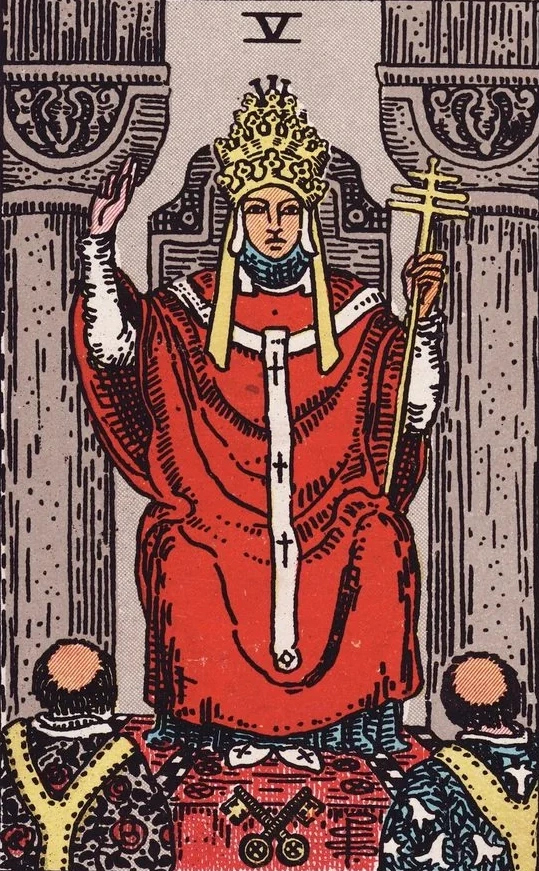
- Ele usa a coroa tripla e está sentado entre dois pilares, mas não são os do Templo guardado pela Sacerdotisa
- Na mão esquerda segura um cetro terminado na cruz tripla, e com a direita dá o conhecido sinal eclesiástico chamado de esoterismo, distinguindo entre a parte manifesta e a oculta da doutrina
- É notável, a este respeito, que a Sacerdotisa não faz sinal algum
- Aos seus pés estão as chaves cruzadas, e dois ministros sacerdotais em alvas ajoelham-se diante dele
- Ele tem sido geralmente chamado o Papa, o que é uma aplicação particular do ofício mais geral que ele simboliza
- Ele é o poder governante da religião externa, como a Sacerdotisa é o génio predominante do poder esotérico e retirado
- Os significados próprios desta carta sofreram uma mistura lamentável por quase todas as mãos
- O Grande Oriente diz verdadeiramente que o Hierofante é o poder das chaves, a doutrina ortodoxa exotérica, e o lado externo da vida que conduz à doutrina
- mas ele certamente não é o príncipe da doutrina oculta, como outro comentador sugeriu
- Ele é antes a summa totius theologiæ, quando passou para a máxima rigidez de expressão
- mas ele simboliza também todas as coisas que são justas e sagradas no lado manifesto
- Como tal, ele é o canal da graça pertencente ao mundo da instituição, distinto do da Natureza, e é o líder da salvação para a raça humana em geral
- Ele é a ordem e a cabeça da hierarquia reconhecida, que é o reflexo de outra e maior ordem hierárquica
- mas pode acontecer que o pontífice esqueça o significado deste seu estado simbólico e aja como se contivesse dentro das suas próprias medidas tudo o que o seu sinal significa ou o seu símbolo procura mostrar
- Ele não é, como se pensou, filosofia, exceto no lado teológico
- ele não é inspiração
- e ele não é religião, embora seja um modo da sua expressão
Descrição da imagem por Waite
He wears the triple crown and is seated between two pillars, but they are not those of the Temple which is guarded by the High Priestess. In his left hand he holds a sceptre terminating in the triple cross, and with his right hand he gives the well-known ecclesiastical sign which is called that of esotericism, distinguishing between the manifest and concealed part of doctrine. It is noticeable in this connexion that the High Priestess makes no sign. At his feet are the crossed keys, and two priestly ministers in albs kneel before him. He has been usually called the Pope, which is a particular application of the more general office that he symbolizes. He is the ruling power of external religion, as the High Priestess is the prevailing genius of the esoteric, withdrawn power. The proper meanings of this card have suffered woeful admixture from nearly all hands. Grand Orient says truly that the Hierophant is the power of the keys, exoteric orthodox doctrine, and the outer side of the life which leads to the doctrine; but he is certainly not the prince of occult doctrine, as another commentator has suggested. He is rather the summa totius theologiæ, when it has passed into the utmost rigidity of expression; but he symbolizes also all things that are righteous and sacred on the manifest side. As such, he is the channel of grace belonging to the world of institution as distinct from that of Nature, and he is the leader of salvation for the human race at large. He is the order and the head of the recognized hierarchy, which is the reflection of another and greater hierarchic order; but it may so happen that the pontiff forgets the significance of this his symbolic state and acts as if he contained within his proper measures all that his sign signifies or his symbol seeks to shew forth. He is not, as it has been thought, philosophy—except on the theological side; he is not inspiration; and he is not religion, although he is a mode of its expression.