O Louco
Arcanos maiores
Resumo da ARCANI
Normal
Um começo sem plano: loucura, embriaguez e liberdade de consequências.
Palavras-chave
- loucura
- embriaguez
- extravagância
- delírio
- frenesi
Invertida
Negligência, descuido e apatia; ausência em vez de presença.
Palavras-chave
- negligência
- descuido
- apatia
- vaidade
- ausência
Notas da imagem · Waite
Trechos das descrições das imagens de Waite, não interpretações adicionais da ARCANI.
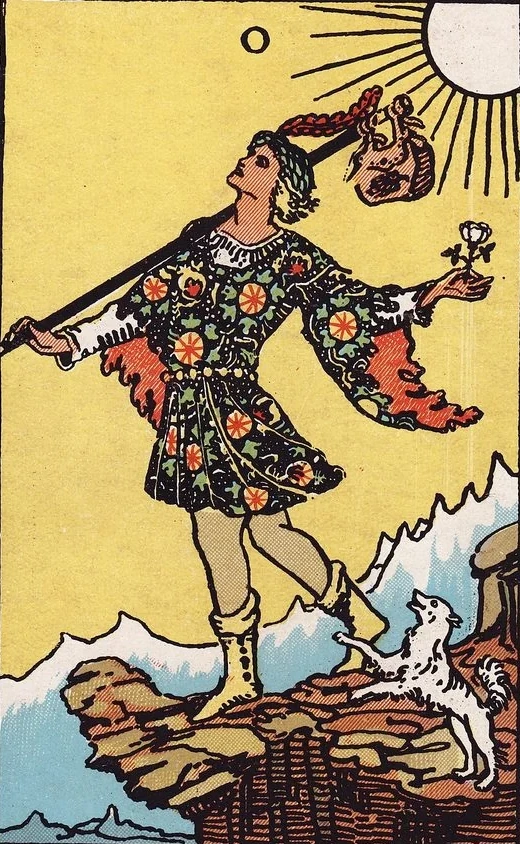
- Com passo leve, como se a terra e os seus entraves tivessem pouco poder para o conter, um jovem em vestes magníficas detém-se à beira de um precipício entre as grandes alturas do mundo
- ele observa a distância azul diante de si, a sua vastidão de céu em vez da vista abaixo
- O seu ato de caminhar ansiosamente ainda está indicado, embora esteja parado no momento dado
- o seu cão ainda salta
- A borda que se abre sobre a profundidade não tem terror
- é como se anjos esperassem para o sustentar, se acontecesse que ele saltasse da altura
- O seu semblante está cheio de inteligência e sonho expectante
- Tem uma rosa numa mão e na outra uma vara custosa, da qual pende sobre o seu ombro direito uma bolsa curiosamente bordada
- Ele é um príncipe do outro mundo nas suas viagens por este, tudo em meio à glória da manhã, no ar cortante
- O sol, que brilha atrás dele, sabe de onde veio, para onde vai e como retornará por outro caminho depois de muitos dias
- Ele é o espírito em busca de experiência
- Muitos símbolos dos Mistérios Instituídos estão resumidos nesta carta, que inverte, sob altas autorizações, todas as confusões que a precederam
- No seu Manual de Cartomancia, o Grande Oriente tem uma sugestão curiosa do ofício de Louco Místico, como parte do seu processo na adivinhação superior
- mas isso poderia exigir mais do que dons comuns para ser posto em prática
- Veremos como a carta se comporta segundo as artes comuns da adivinhação, e será um exemplo, para aqueles que podem discernir, do fato, de outro modo tão evidente, de que os Arcanos Maiores não tinham lugar originalmente nas artes do jogo psíquico, quando as cartas são usadas como contadores e pretextos
- Das circunstâncias sob as quais esta arte surgiu, sabemos, no entanto, muito pouco
- As explicações convencionais dizem que o Louco significa a carne, a vida sensitiva, e por uma sátira peculiar o seu nome subsidiário foi em tempos o alquimista, como retratando a loucura no seu estágio mais insensato
Descrição da imagem por Waite
With light step, as if earth and its trammels had little power to restrain him, a young man in gorgeous vestments pauses at the brink of a precipice among the great heights of the world; he surveys the blue distance before him—its expanse of sky rather than the prospect below. His act of eager walking is still indicated, though he is stationary at the given moment; his dog is still bounding. The edge which opens on the depth has no terror; it is as if angels were waiting to uphold him, if it came about that he leaped from the height. His countenance is full of intelligence and expectant dream. He has a rose in one hand and in the other a costly wand, from which depends over his right shoulder a wallet curiously embroidered. He is a prince of the other world on his travels through this one—all amidst the morning glory, in the keen air. The sun, which shines behind him, knows whence he came, whither he is going, and how he will return by another path after many days. He is the spirit in search of experience. Many symbols of the Instituted Mysteries are summarized in this card, which reverses, under high warrants, all the confusions that have preceded it. In his Manual of Cartomancy, Grand Orient has a curious suggestion of the office of Mystic Fool, as a part of his process in higher divination; but it might call for more than ordinary gifts to put it into operation. We shall see how the card fares according to the common arts of fortune-telling, and it will be an example, to those who can discern, of the fact, otherwise so evident, that the Trumps Major had no place originally in the arts of psychic gambling, when cards are used as the counters and pretexts. Of the circumstances under which this art arose we know, however, very little. The conventional explanations say that the Fool signifies the flesh, the sensitive life, and by a peculiar satire its subsidiary name was at one time the alchemist, as depicting folly at the most insensate stage.