
Gli Amanti
Arcani maggiori
Sintesi ARCANI
Al diritto
Attrazione, amore e bellezza; prove superate.
Parole chiave
- attrazione
- amore
- bellezza
- prove superate
Capovolta
Fallimento e disegni sciocchi; o, secondo un’altra versione, matrimonio frustrato.
Parole chiave
- fallimento
- disegni sciocchi
- matrimonio frustrato
- contrarietà
Note sull’immagine · Waite
Estratti dalle descrizioni delle immagini di Waite, non interpretazioni aggiuntive di ARCANI.
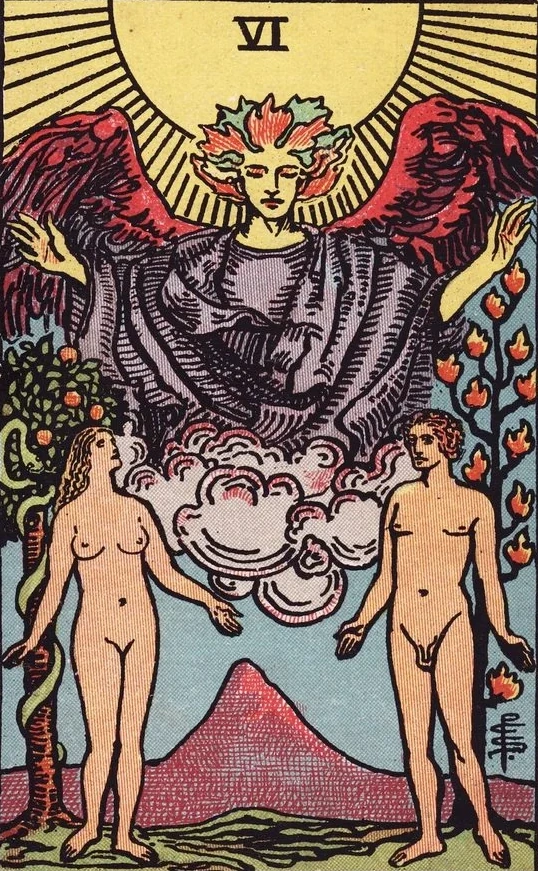
- Il sole splende allo zenit, e sotto vi è una grande figura alata con le braccia distese, che riversa influenze
- In primo piano sono due figure umane, maschio e femmina, svelate l’una davanti all’altra, come Adamo ed Eva quando occuparono per la prima volta il paradiso del corpo terrestre
- Dietro l’uomo è l’Albero della Vita, che porta dodici frutti, e l’Albero della Conoscenza del Bene e del Male è dietro la donna
- il serpente vi si avvolge intorno
- Le figure suggeriscono giovinezza, verginità, innocenza e amore prima che sia contaminato dal desiderio materiale grossolano
- Questa è, in tutta semplicità, la carta dell’amore umano, qui esibito come parte della via, della verità e della vita
- Sostituisce, ricorrendo ai primi principi, la vecchia carta del matrimonio, che ho descritto in precedenza, e le follie successive che raffiguravano l’uomo tra vizio e virtù
- In un senso molto alto, la carta è un mistero dell’Alleanza e del Sabato
- La suggestione riguardo alla donna è che ella significhi quell’attrazione verso la vita sensitiva che porta in sé l’idea della Caduta dell’Uomo, ma ella è piuttosto l’opera di una Legge segreta della Provvidenza che una tentatrice volente e cosciente
- È attraverso la sua caduta imputata che l’uomo si solleverà in definitiva, e solo per mezzo di lei può completare se stesso
- La carta è dunque, a suo modo, un’altra allusione al grande mistero della femminilità
- I vecchi significati cadono necessariamente in pezzi con le vecchie immagini, ma anche come interpretazioni di queste ultime alcuni erano dell’ordine del luogo comune e altri erano falsi nel simbolismo
Descrizione dell’immagine di Waite
The sun shines in the zenith, and beneath is a great winged figure with arms extended, pouring down influences. In the foreground are two human figures, male and female, unveiled before each other, as if Adam and Eve when they first occupied the paradise of the earthly body. Behind the man is the Tree of Life, bearing twelve fruits, and the Tree of the Knowledge of Good and Evil is behind the woman; the serpent is twining round it. The figures suggest youth, virginity, innocence and love before it is contaminated by gross material desire. This is in all simplicity the card of human love, here exhibited as part of the way, the truth and the life. It replaces, by recourse to first principles, the old card of marriage, which I have described previously, and the later follies which depicted man between vice and virtue. In a very high sense, the card is a mystery of the Covenant and Sabbath. The suggestion in respect of the woman is that she signifies that attraction towards the sensitive life which carries within it the idea of the Fall of Man, but she is rather the working of a Secret Law of Providence than a willing and conscious temptress. It is through her imputed lapse that man shall arise ultimately, and only by her can he complete himself. The card is therefore in its way another intimation concerning the great mystery of womanhood. The old meanings fall to pieces of necessity with the old pictures, but even as interpretations of the latter, some of them were of the order of commonplace and others were false in symbolism.