


El Carro
Arcanos mayores
Resumen de ARCANI
Al derecho
Socorro y providencia; también guerra, triunfo, presunción, venganza y problemas.
Palabras clave
- socorro
- providencia
- guerra
- triunfo
- presunción
- problemas
Invertida
Disturbio, pelea, disputa, litigio y derrota.
Palabras clave
- disturbio
- pelea
- disputa
- litigio
- derrota
Notas de la imagen · Waite
Extractos de las descripciones de las imágenes de Waite, no interpretaciones adicionales de ARCANI.
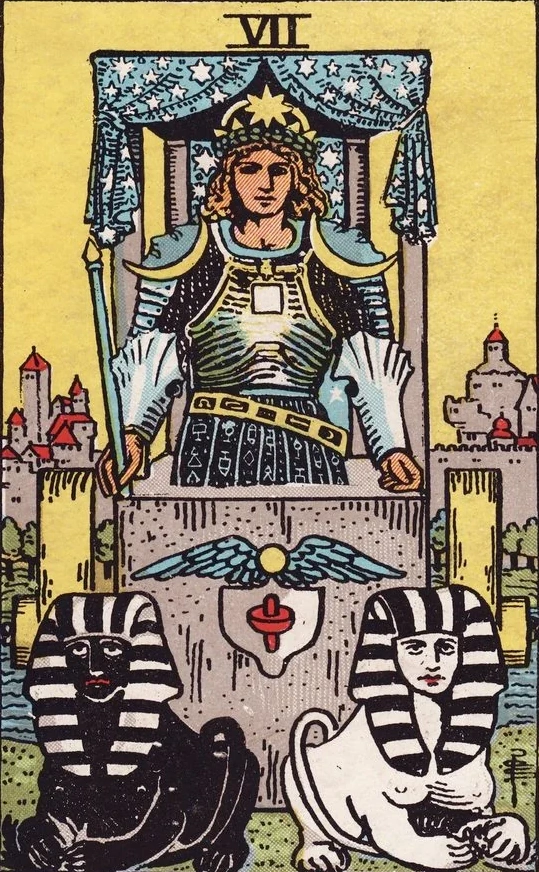
- Una figura erecta y principesca que lleva una espada desenvainada y corresponde, en términos generales, a la descripción tradicional que he dado en la primera parte
- Sobre los hombros del héroe victorioso se supone que están el Urim y Tumim
- Ha llevado cautiva la cautividad
- es conquista en todos los planos: en la mente, en la ciencia, en el progreso, en ciertas pruebas de iniciación
- Ha respondido así a la esfinge, y es por esta razón que he aceptado la variación de Éliphas Lévi
- dos esfinges tiran así de su carro
- Es sobre todo triunfo en la mente
- Debe entenderse por esta razón (a) que la pregunta de la esfinge se refiere a un Misterio de la Naturaleza y no del mundo de la Gracia, a la que el auriga no podría ofrecer respuesta
- (b) que los planos de su conquista son manifiestos o externos y no dentro de sí mismo
- (c) que la liberación que efectúa puede dejarlo en la esclavitud del entendimiento lógico
- (d) que las pruebas de iniciación por las que ha pasado en triunfo deben entenderse física o racionalmente
- y (e) que si llegara a las columnas de ese Templo entre las que está sentada la Sacerdotisa, no podría abrir el rollo llamado Tora, ni si ella le preguntara podría responder
- No es realeza hereditaria y no es sacerdocio
Descripción de la imagen de Waite
An erect and princely figure carrying a drawn sword and corresponding, broadly speaking, to the traditional description which I have given in the first part. On the shoulders of the victorious hero are supposed to be the Urim and Thummim. He has led captivity captive; he is conquest on all planes—in the mind, in science, in progress, in certain trials of initiation. He has thus replied to the sphinx, and it is on this account that I have accepted the variation of Éliphas Lévi; two sphinxes thus draw his chariot. He is above all things triumph in the mind. It is to be understood for this reason (a) that the question of the sphinx is concerned with a Mystery of Nature and not of the world of Grace, to which the charioteer could offer no answer; (b) that the planes of his conquest are manifest or external and not within himself; (c) that the liberation which he effects may leave himself in the bondage of the logical understanding; (d) that the tests of initiation through which he has passed in triumph are to be understood physically or rationally; and (e) that if he came to the pillars of that Temple between which the High Priestess is seated, he could not open the scroll called Tora, nor if she questioned him could he answer. He is not hereditary royalty and he is not priesthood.