
Los Enamorados
Arcanos mayores
Resumen de ARCANI
Al derecho
Atracción, amor y belleza; pruebas superadas.
Palabras clave
- atracción
- amor
- belleza
- pruebas superadas
Invertida
Fracaso y designios necios; o, según otra versión, matrimonio frustrado.
Palabras clave
- fracaso
- designios necios
- matrimonio frustrado
- contrariedad
Notas de la imagen · Waite
Extractos de las descripciones de las imágenes de Waite, no interpretaciones adicionales de ARCANI.
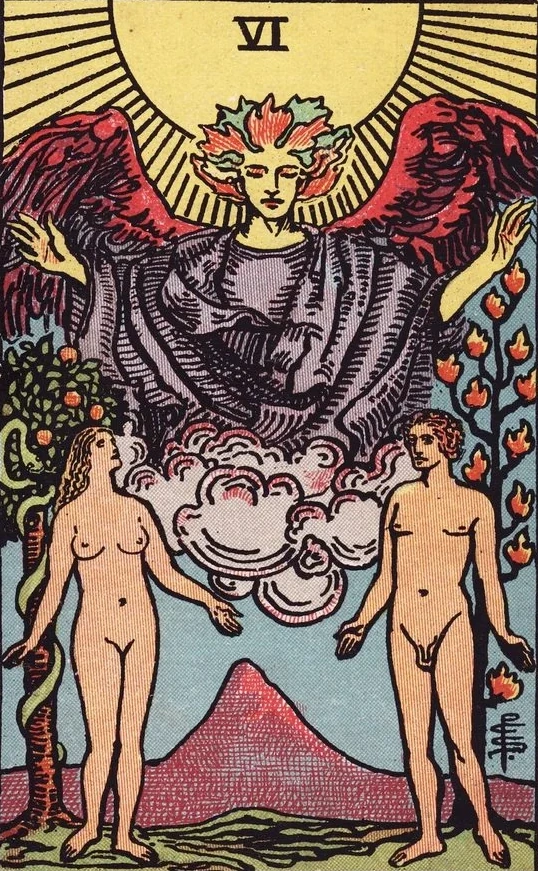
- El sol brilla en el cenit, y debajo hay una gran figura alada con los brazos extendidos, derramando influencias
- En primer plano hay dos figuras humanas, masculina y femenina, desveladas ante el otro, como Adán y Eva cuando ocuparon por primera vez el paraíso del cuerpo terrenal
- Detrás del hombre está el Árbol de la Vida, que lleva doce frutos, y el Árbol del Conocimiento del Bien y del Mal está detrás de la mujer
- la serpiente se enrosca alrededor de él
- Las figuras sugieren juventud, virginidad, inocencia y amor antes de ser contaminado por el deseo material grosero
- Esta es, con toda sencillez, la carta del amor humano, exhibida aquí como parte del camino, la verdad y la vida
- Reemplaza, recurriendo a los primeros principios, la antigua carta del matrimonio, que he descrito antes, y las locuras posteriores que representaban al hombre entre el vicio y la virtud
- En un sentido muy elevado, la carta es un misterio del Pacto y del Sábado
- La sugerencia respecto a la mujer es que significa esa atracción hacia la vida sensitiva que lleva en sí la idea de la Caída del Hombre, pero ella es más bien la operación de una Ley Secreta de la Providencia que una tentadora voluntaria y consciente
- Es a través de su lapsus imputado que el hombre se levantará en última instancia, y solo por ella puede completarse
- La carta es, por tanto, a su manera, otra insinuación sobre el gran misterio de la feminidad
- Los viejos significados se desmoronan necesariamente con las viejas imágenes, pero incluso como interpretaciones de estas últimas, algunos eran de orden común y otros eran falsos en el simbolismo
Descripción de la imagen de Waite
The sun shines in the zenith, and beneath is a great winged figure with arms extended, pouring down influences. In the foreground are two human figures, male and female, unveiled before each other, as if Adam and Eve when they first occupied the paradise of the earthly body. Behind the man is the Tree of Life, bearing twelve fruits, and the Tree of the Knowledge of Good and Evil is behind the woman; the serpent is twining round it. The figures suggest youth, virginity, innocence and love before it is contaminated by gross material desire. This is in all simplicity the card of human love, here exhibited as part of the way, the truth and the life. It replaces, by recourse to first principles, the old card of marriage, which I have described previously, and the later follies which depicted man between vice and virtue. In a very high sense, the card is a mystery of the Covenant and Sabbath. The suggestion in respect of the woman is that she signifies that attraction towards the sensitive life which carries within it the idea of the Fall of Man, but she is rather the working of a Secret Law of Providence than a willing and conscious temptress. It is through her imputed lapse that man shall arise ultimately, and only by her can he complete himself. The card is therefore in its way another intimation concerning the great mystery of womanhood. The old meanings fall to pieces of necessity with the old pictures, but even as interpretations of the latter, some of them were of the order of commonplace and others were false in symbolism.