El Juicio
Arcanos mayores
Resumen de ARCANI
Al derecho
Cambio de posición, renovación y resultado; según otra lectura, pérdida total por pleito.
Palabras clave
- cambio de posición
- renovación
- resultado
- pérdida por pleito
Invertida
Debilidad, pusilanimidad y sencillez; también deliberación, decisión y sentencia.
Palabras clave
- debilidad
- pusilanimidad
- sencillez
- decisión
Notas de la imagen · Waite
Extractos de las descripciones de las imágenes de Waite, no interpretaciones adicionales de ARCANI.
- He dicho que este símbolo es esencialmente invariable en todos los conjuntos del Tarot, o al menos las variaciones no alteran su carácter
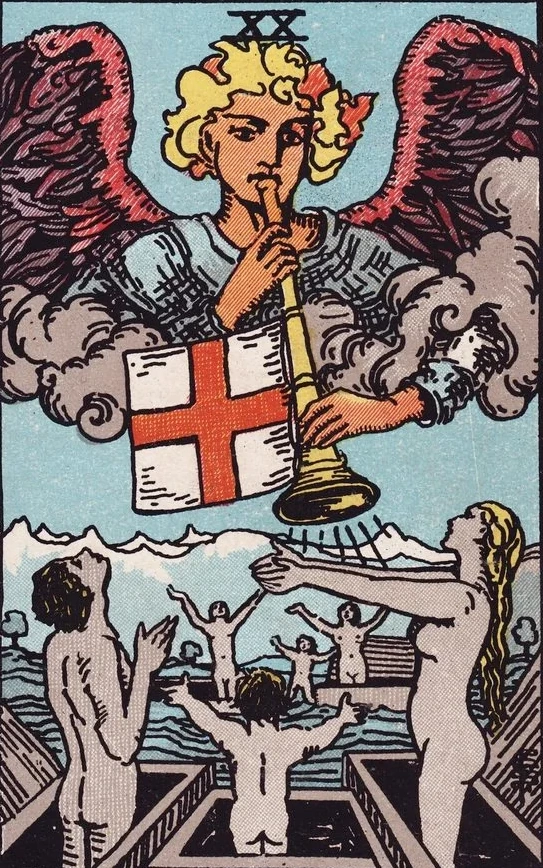
- El gran ángel está aquí rodeado de nubes, pero sopla su trompeta con estandarte, y la cruz, como de costumbre, se muestra en el estandarte
- Los muertos se levantan de sus tumbas: una mujer a la derecha, un hombre a la izquierda, y entre ellos su hijo, de espaldas
- Pero en esta carta hay más de tres que son restaurados, y se ha considerado oportuno hacer esta variación para ilustrar la insuficiencia de las explicaciones corrientes
- Debe notarse que todas las figuras son una sola en el asombro, la adoración y el éxtasis expresados por sus actitudes
- Es la carta que registra la realización de la gran obra de transformación en respuesta al llamado del Superno, llamado que se oye y se responde desde dentro
- Aquí está la indicación de un significado que no puede llevarse mucho más lejos en este lugar
- ¿Qué es eso dentro de nosotros que hace sonar una trompeta y todo lo inferior de nuestra naturaleza se levanta en respuesta, casi en un momento, casi en un abrir y cerrar de ojos? Que la carta siga representando, para quienes no pueden ver más allá, el Juicio Final y la resurrección en el cuerpo natural
- pero que quienes tienen ojos interiores miren y descubran con ellos
- Comprenderán que en el pasado se la ha llamado con razón una carta de vida eterna, y por esta razón puede compararse con la que pasa bajo el nombre de La Templanza
Descripción de la imagen de Waite
I have said that this symbol is essentially invariable in all Tarot sets, or at least the variations do not alter its character. The great angel is here encompassed by clouds, but he blows his bannered trumpet, and the cross as usual is displayed on the banner. The dead are rising from their tombs—a woman on the right, a man on the left hand, and between them their child, whose back is turned. But in this card there are more than three who are restored, and it has been thought worth while to make this variation as illustrating the insufficiency of current explanations. It should be noted that all the figures are as one in the wonder, adoration and ecstacy expressed by their attitudes. It is the card which registers the accomplishment of the great work of transformation in answer to the summons of the Supernal—which summons is heard and answered from within. Herein is the intimation of a significance which cannot well be carried further in the present place. What is that within us which does sound a trumpet and all that is lower in our nature rises in response—almost in a moment, almost in the twinkling of an eye? Let the card continue to depict, for those who can see no further, the Last Judgment and the resurrection in the natural body; but let those who have inward eyes look and discover therewith. They will understand that it has been called truly in the past a card of eternal life, and for this reason it may be compared with that which passes under the name of Temperance.