L’Empereur
Arcanes majeurs
Synthèse ARCANI
À l’endroit
Stabilité, pouvoir et protection ; raison, conviction, autorité et volonté.
Mots-clés
- stabilité
- pouvoir
- protection
- réalisation
- raison
- conviction
Renversée
Bienveillance et crédit ; aussi confusion pour les ennemis, obstruction et immaturité.
Mots-clés
- bienveillance
- compassion
- obstruction
- immaturité
Notes sur l’image · Waite
Extraits des descriptions des images par Waite, et non interprétations supplémentaires d’ARCANI.
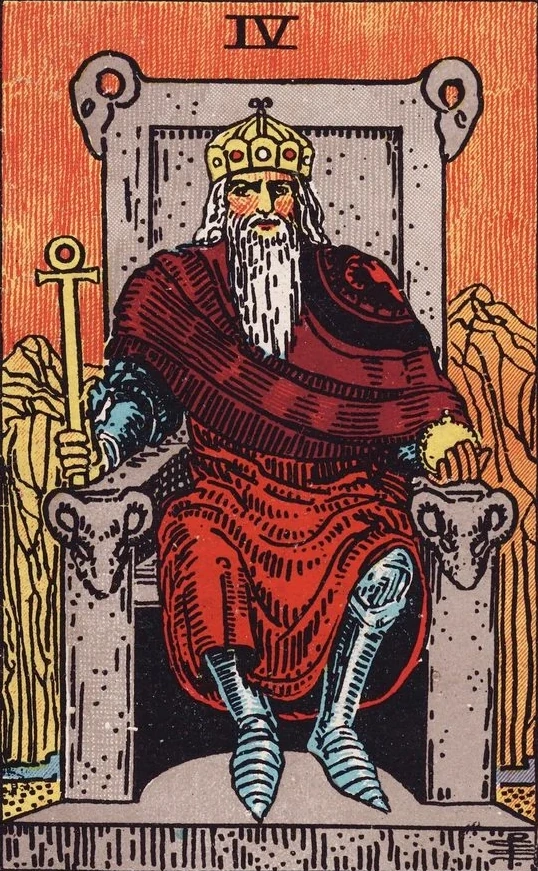
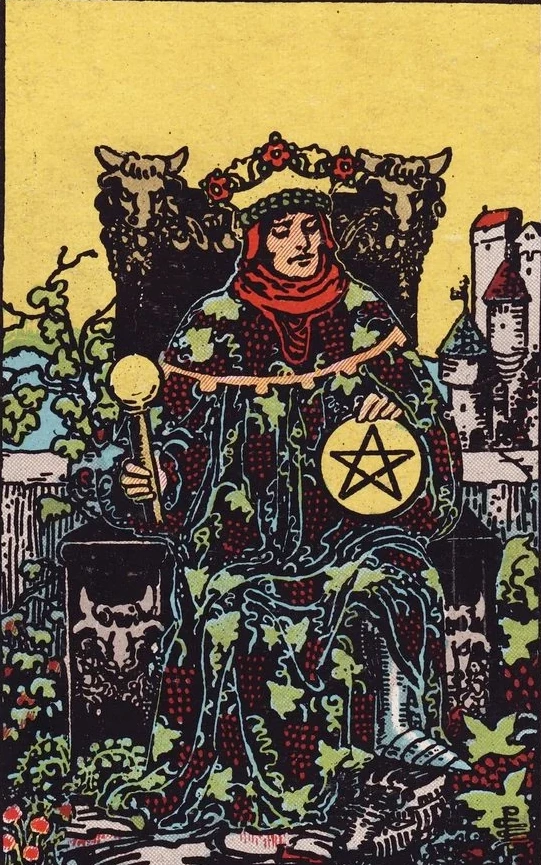
- Il a une forme de Crux ansata pour sceptre et un globe dans la main gauche
- C’est un monarque couronné, commandant, majestueux, assis sur un trône dont les accoudoirs sont ornés de têtes de béliers
- Il est exécutif et réalisation, le pouvoir de ce monde, ici revêtu des plus hauts de ses attributs naturels
- Il est parfois représenté assis sur une pierre cubique, ce qui toutefois embrouille certaines des questions
- Il est le pouvoir viril, auquel l’Impératrice répond, et en ce sens il est celui qui cherche à lever le Voile d’Isis
- mais elle reste virgo intacta
- Il faut comprendre que cette carte et celle de l’Impératrice ne représentent pas précisément l’état de vie conjugale, bien que cet état soit impliqué
- En surface, comme je l’ai indiqué, elles représentent la royauté mondaine, élevée sur les sièges des puissants
- mais au-dessus de cela il y a la suggestion d’une autre présence
- Elles signifient aussi, et la figure masculine en particulier, la royauté supérieure, occupant le trône intellectuel
- C’est la seigneurie de la pensée plutôt que du monde animal
- Les deux personnalités, à leur manière, sont « pleines d’étrange expérience », mais la leur n’est pas consciemment la sagesse qui puise à un monde supérieur
- L’Empereur a été décrit comme (a) la volonté sous sa forme incarnée, mais ce n’est là qu’une de ses applications, et (b) comme une expression des virtualités contenues dans l’Être absolu, mais c’est une fantaisie
Description de l’image par Waite
He has a form of the Crux ansata for his sceptre and a globe in his left hand. He is a crowned monarch—commanding, stately, seated on a throne, the arms of which are fronted by rams' heads. He is executive and realization, the power of this world, here clothed with the highest of its natural attributes. He is occasionally represented as seated on a cubic stone, which, however, confuses some of the issues. He is the virile power, to which the Empress responds, and in this sense is he who seeks to remove the Veil of Isis; yet she remains virgo intacta. It should be understood that this card and that of the Empress do not precisely represent the condition of married life, though this state is implied. On the surface, as I have indicated, they stand for mundane royalty, uplifted on the seats of the mighty; but above this there is the suggestion of another presence. They signify also—and the male figure especially—the higher kingship, occupying the intellectual throne. Hereof is the lordship of thought rather than of the animal world. Both personalities, after their own manner, are "full of strange experience," but theirs is not consciously the wisdom which draws from a higher world. The Emperor has been described as (a) will in its embodied form, but this is only one of its applications, and (b) as an expression of virtualities contained in the Absolute Being—but this is fantasy.