
Le Diable
Arcanes majeurs
Synthèse ARCANI
À l’endroit
Ravage, violence et force ; fatalité, et ce qui est prédestiné mais non pour autant mauvais.
Mots-clés
- ravage
- violence
- force
- fatalité
- prédestination
Renversée
Fatalité mauvaise ; faiblesse, mesquinerie et aveuglement.
Mots-clés
- fatalité mauvaise
- faiblesse
- mesquinerie
- aveuglement
Notes sur l’image · Waite
Extraits des descriptions des images par Waite, et non interprétations supplémentaires d’ARCANI.
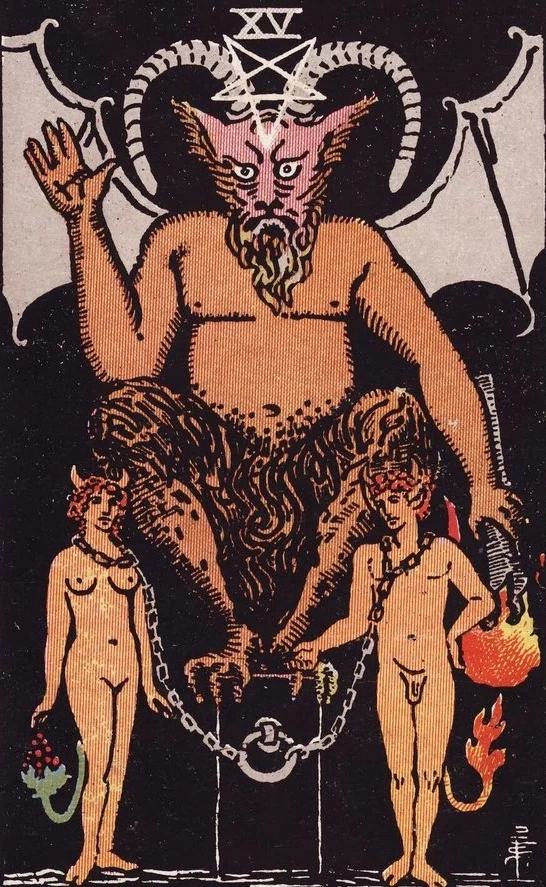
- Le dessin est un accommodement, un moyen ou une harmonie, entre plusieurs motifs mentionnés dans la première partie
- Le Bouc Cornu de Mendès, avec des ailes comme celles d’une chauve-souris, se tient sur un autel
- Au creux de l’estomac se trouve le signe de Mercure
- La main droite est levée et étendue, à l’inverse de la bénédiction donnée par le Pape dans la cinquième carte
- Dans la main gauche il y a une grande torche enflammée, renversée vers la terre
- Un pentagramme inversé est sur le front
- Il y a un anneau devant l’autel, d’où partent deux chaînes attachées au cou de deux figures, un homme et une femme
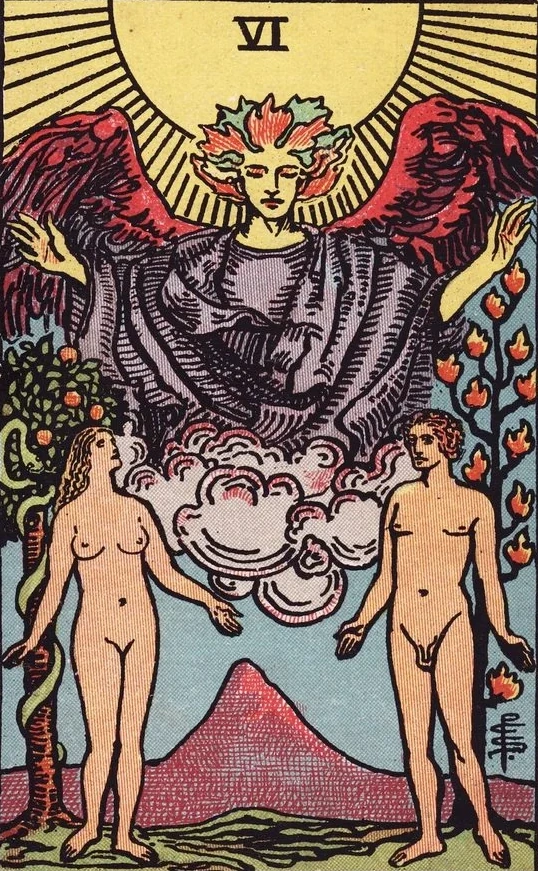
- Celles-ci sont analogues à celles de la cinquième carte, comme si c’étaient Adam et Ève après la Chute
- Il y a là la chaîne et la fatalité de la vie matérielle
- Les figures ont une queue, pour signifier la nature animale, mais il y a une intelligence humaine dans les visages, et celui qui est exalté au-dessus d’elles ne doit pas être leur maître pour toujours
- Dès maintenant, il est lui aussi un esclave, soutenu par le mal qui est en lui et aveugle à la liberté du service
- Avec plus que sa dérision habituelle pour les arts qu’il prétendait respecter et interpréter en maître, Éliphas Lévi affirme que la figure baphométique est science occulte et magie
- Un autre commentateur dit que, dans le monde Divin, elle signifie la prédestination, mais il n’y a dans ce monde aucune correspondance avec les choses qui, en bas, relèvent de la brute
- Ce qu’elle signifie vraiment, c’est l’Habitant du Seuil, hors du Jardin Mystique, lorsque en sont chassés ceux qui ont mangé le fruit défendu
Description de l’image par Waite
The design is an accommodation, mean or harmony, between several motives mentioned in the first part. The Horned Goat of Mendes, with wings like those of a bat, is standing on an altar. At the pit of the stomach there is the sign of Mercury. The right hand is upraised and extended, being the reverse of that benediction which is given by the Hierophant in the fifth card. In the left hand there is a great flaming torch, inverted towards the earth. A reversed pentagram is on the forehead. There is a ring in front of the altar, from which two chains are carried to the necks of two figures, male and female. These are analogous with those of the fifth card, as if Adam and Eve after the Fall. Hereof is the chain and fatality of the material life. The figures are tailed, to signify the animal nature, but there is human intelligence in the faces, and he who is exalted above them is not to be their master for ever. Even now, he is also a bondsman, sustained by the evil that is in him and blind to the liberty of service. With more than his usual derision for the arts which he pretended to respect and interpret as a master therein, Éliphas Lévi affirms that the Baphometic figure is occult science and magic. Another commentator says that in the Divine world it signifies predestination, but there is no correspondence in that world with the things which below are of the brute. What it does signify is the Dweller on the Threshold without the Mystical Garden when those are driven forth therefrom who have eaten the forbidden fruit.