Der Mond
Große Arkana
ARCANI-Zusammenfassung
Aufrecht
Verborgene Feinde und Gefahr; Dunkelheit, Schrecken, Täuschung, okkulte Kräfte und Irrtum.
Schlüsselwörter
- verborgene Feinde
- Gefahr
- Dunkelheit
- Schrecken
- Täuschung
- Irrtum
Umgekehrt
Unbeständigkeit und Wankelmut; Schweigen sowie geringere Täuschung und geringerer Irrtum.
Schlüsselwörter
- Unbeständigkeit
- Wankelmut
- Schweigen
- geringere Täuschung
Bildnotizen · Waite
Auszüge aus Waites Bildbeschreibungen, keine zusätzlichen Deutungen von ARCANI.
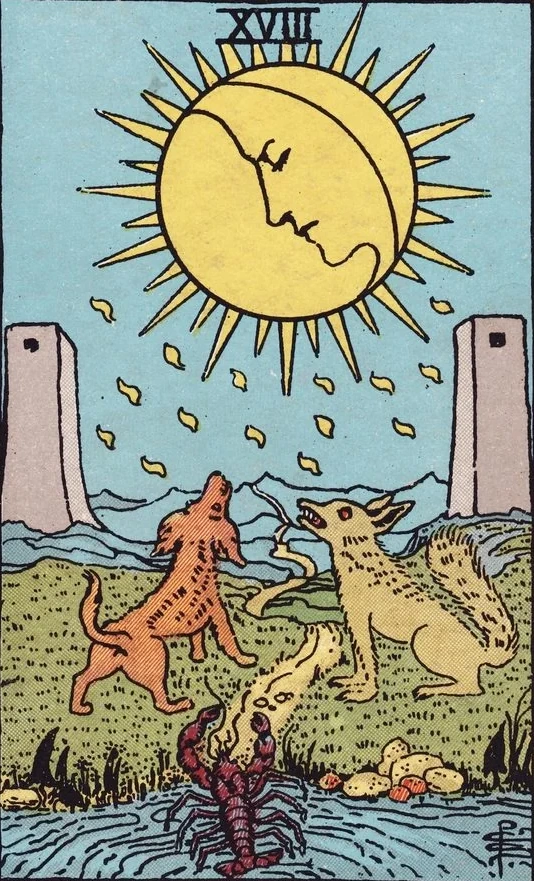
- Der Unterschied zwischen dieser Karte und einigen der herkömmlichen Typen besteht darin, dass der Mond auf der sogenannten Seite der Barmherzigkeit zunimmt, rechts vom Betrachter
- Er hat sechzehn Haupt- und sechzehn Nebenstrahlen
- Die Karte stellt das Leben der Einbildungskraft dar, getrennt vom Leben des Geistes
- Der Weg zwischen den Türmen ist der Ausgang ins Unbekannte
- Der Hund und der Wolf sind die Ängste des natürlichen Geistes angesichts dieses Ortes des Ausgangs, wenn nur reflektiertes Licht ihn leitet
- Der letzte Hinweis ist ein Schlüssel zu einer anderen Form der Symbolik
- Das intellektuelle Licht ist ein Widerschein, und jenseits davon liegt das unbekannte Geheimnis, das es nicht darzulegen vermag
- Es erleuchtet unsere tierische Natur, deren Typen unten dargestellt sind: der Hund, der Wolf und jenes, das aus den Tiefen emporsteigt, die namenlose und abscheuliche Neigung, die tiefer steht als das wilde Tier
- Es strebt nach Offenbarung, symbolisiert durch das Kriechen aus dem Abgrund des Wassers zum Land, doch in der Regel sinkt es dorthin zurück, woher es kam
- Das Antlitz des Geistes richtet einen ruhigen Blick auf die Unruhe darunter
- der Tau des Gedankens fällt
- die Botschaft lautet: Friede, sei still
- und es mag geschehen, dass eine Ruhe über die tierische Natur kommt, während der Abgrund darunter aufhört, eine Gestalt heraufzugeben
Waites Beschreibung des Bildes
The distinction between this card and some of the conventional types is that the moon is increasing on what is called the side of mercy, to the right of the observer. It has sixteen chief and sixteen secondary rays. The card represents life of the imagination apart from life of the spirit. The path between the towers is the issue into the unknown. The dog and wolf are the fears of the natural mind in the presence of that place of exit, when there is only reflected light to guide it. The last reference is a key to another form of symbolism. The intellectual light is a reflection and beyond it is the unknown mystery which it cannot shew forth. It illuminates our animal nature, types of which are represented below—the dog, the wolf and that which comes up out of the deeps, the nameless and hideous tendency which is lower than the savage beast. It strives to attain manifestation, symbolized by crawling from the abyss of water to the land, but as a rule it sinks back whence it came. The face of the mind directs a calm gaze upon the unrest below; the dew of thought falls; the message is: Peace, be still; and it may be that there shall come a calm upon the animal nature, while the abyss beneath shall cease from giving up a form.